

Image Details
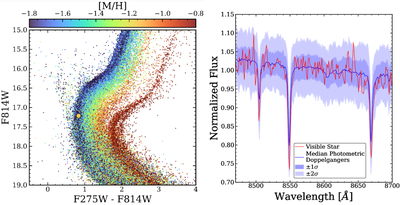
Caption: Figure 2.
Visible star properties. Left: extinction-corrected color–magnitude diagram (CMD) combining photometry from M. Häberle et al. (2024a) and spectroscopic metallicities from M. S. Nitschai et al. (2023). Based on its position in the CMD, it is a turnoff star with [M/H] = −1.75 ± 0.25. Right: MUSE spectra of the visible star (red) vs. other stars with similar color (blue). The blue line and shaded regions show the median, 1σ, and 2σ range of the 260 stellar spectra selected as photometric doppelgangers (within 0.02 mag in both color and magnitude in the left CMD). The red line shows the calcium triplet lines are slightly deeper than for stars of similar color, and most consistent with [M/H] = −1.5. The combined photometric and spectroscopic data suggest [M/H] in the range −1.75 to −1.5.
Other Images in This Article
Copyright and Terms & Conditions
© 2026. The Author(s). Published by the American Astronomical Society.

