

Image Details
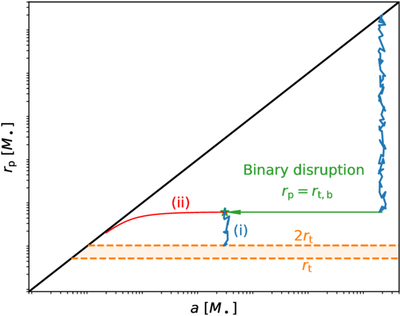
Caption: Figure 5.
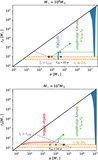
A cartoon illustrating the outcomes of binary disruption, leading to rpTDEs and stellar EMRIs. In the first stage, a stellar binary is randomly scattered by background stars and gets disrupted when the pericenter distance rp approaches rt,b. Immediately after binary disruption, the captured star has a pericenter distance larger than the stellar tidal radius rt. In the second stage, the captured star is either (i) randomly scattered by background stars (when tJ ≲ tGW) and finally ends as an rpTDE when it diffuses to the loss-cone boundary of rpTDEs rp ≃ 2rt, or (ii) is driven by gravitational radiation (when tGW ≲ tJ) to become a stellar EMRI.
Other Images in This Article
Copyright and Terms & Conditions
© 2026. The Author(s). Published by the American Astronomical Society.

