

Image Details
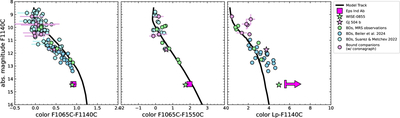
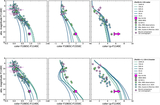
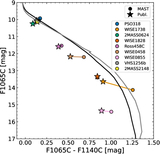
Caption: Figure 3.
CMD positions of Eps Ind Ab, as well as a number of other cold brown dwarfs (with details provided in Appendix A), considering the three JWST filters as well as the NaCo L’ filter (for which there is a nondetection of Eps Ind Ab; the base of the arrow is the 5σ lower limit in L’ − F1065C color for this planet). The models are from the Sonora Flame Skimmer grid (J. Mang et al. 2026, in preparation) and have solar metallicity and C/O and Kzz = 107 cm−2 s−1. These models broadly explain the population of warmer brown dwarfs and, in particular, the trend whereby the F1065C − F1140C color becomes increasingly red, tracing an increasingly deep ammonia feature, in cooler brown dwarfs. However, both Eps Ind Ab and WISE 0855 show significantly bluer F1065C − F1140C colors than these simple models, indicating that the ammonia feature is smaller than expected. Eps Ind Ab and WISE 0855 have remarkably similar mid-IR magnitudes and colors, but Eps Ind Ab is significantly redder in L’ − F1065C (i.e., it is significantly fainter at L’), and we discuss potential explanations in the text.
Other Images in This Article
Copyright and Terms & Conditions
© 2026. The Author(s). Published by the American Astronomical Society.

