

Image Details
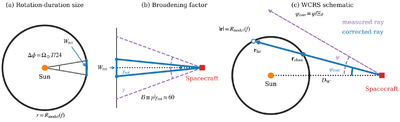
Caption: Figure 5.
Geometry to relate rotation durations and direction-finding angles to a physical source size and to the WCRS correction. (a) A corotating source at heliocentric radius r = Rmodel(f) rotates through Δϕ = Ω⊙T/24 during an interval of duration T (in hours), corresponding to a transverse chord length ﹩{W}_{{\rm{rot}}}=2r\sin ({\rm{\Delta }}\phi /2)﹩. (b) The same chord subtends a geometric angular half-width γrot at the spacecraft (Sun–spacecraft distance DSC); comparing with the goniopolarimetric apparent half-width γ defines the angular-broadening factor ﹩{ \mathcal B }\equiv \gamma /{\gamma }_{{\rm{rot}}}﹩. (c) Schematic of the WCRS construction: the measured direction finding ray (dashed purple) has an angular deviation ψ from the Sun–spacecraft line; applying the scattering correction shrinks the deviation to ψcorr = ψ/ΞF (solid blue). Intersecting the corrected ray with the density model sphere ∣r∣ = Rmodel(f) yields the near- and farside solutions rclose and rfar.
Other Images in This Article
Copyright and Terms & Conditions
© 2026. The Author(s). Published by the American Astronomical Society.

