

Image Details
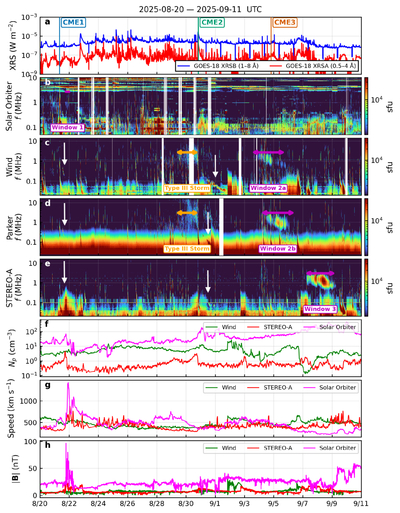
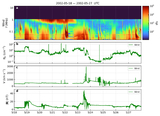
Caption: Figure 3.
Overview of flare, radio, and in situ context for the long-duration type IV event. (a) GOES-18 X-ray flux (1–8 Å). Because GOES is an Earth-view proxy, panel (a) may not capture farside activity during Window 1/CME1. (b)–(e) Radio dynamic spectra from four spacecraft: (b) Solar Orbiter/RPW, (c) Wind/WAVES, (d) Parker Solar Probe/FIELDS, and (e) STEREO-A/WAVES. (f)–(h) In situ solar wind parameters measured at Wind (green) and STEREO-A (red): (f) Proton density np, (g) bulk speed VSW, and (h) magnetic field strength ∣B∣. Solar Orbiter (magenta) is also shown for np and VSW. Vertical lines in panel (a) indicate the launch times of the three fast CMEs, color coded as in Figure 2 (times from DONKI; see the text). The white arrows in panels (c)–(e) indicate type II bursts.
Other Images in This Article
Copyright and Terms & Conditions
© 2026. The Author(s). Published by the American Astronomical Society.

