

Image Details
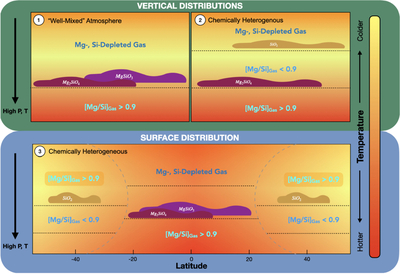
Caption: Figure 5.
Schematic detailing potential atmospheric distributions of silicate cloud species with altitude. Vertical distributions (top panel) show 1D slices of an atmosphere, descending from top (low pressure, temperature) to bottom (high pressure, temperature). On the top left is the case for a “well-mixed” atmosphere where pressure layers are not chemically differentiated. On the top right is a case for a chemically inhomogeneous atmosphere where convective cycling may inhibit atmospheric pressure layers from equilibrating. A surface distribution (bottom panel) shows 1D slices of an atmosphere along different latitudinal regions, where chemical inhomogeneity may not only be due to vertical mixing but also driven by differences in horizontal transport from equator to pole. Black dashed lines represent condensation points for different silicate species (not to scale). Background color correlates to atmospheric temperatures of irradiated atmospheres, although these types of dynamics may also be present in nonirradiated atmospheres. All three scenarios assume a given object has a bulk Mg/Si ratio > 0.9.
Other Images in This Article
Copyright and Terms & Conditions
© 2026. The Author(s). Published by the American Astronomical Society.

