

Image Details
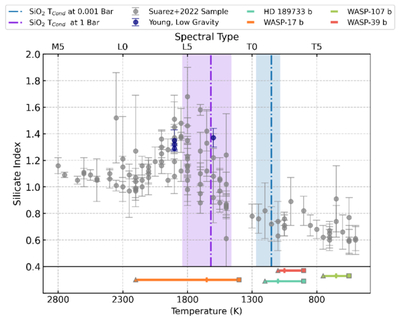
Caption: Figure 3.
We show an adaptation of the silicate index versus spectral type (or temperature) as published in G. Suárez & S. Metchev (2022). Silicate index for the brown dwarf population observed with the Spitzer Space Telescope (gray points) is discussed in G. Suárez & S. Metchev (2022). Additionally, we highlight in navy four brown dwarfs categorized as young, low-gravity objects from G. Suárez & S. Metchev (2023). At the bottom, we plot the range of temperatures for the four JWST-observed and retrieved giant exoplanets explored in this work, indicating where they might land on this distribution if a silicate index were possible to calculate. Dayside temperature is indicated by a triangle, nightside temperature by a square, and Teq by an intersecting line. We also plot the condensation temperatures for quartz at 1 bar (purple) and 0.001 bar (blue) as estimates of photospheric silicate condensation points in brown dwarfs and giant planets, respectively. Corresponding colored bands represent the range of TCond for quartz at [Fe/H] = 0.1 x solar (cooler) and [Fe/H] = 10 x solar (warmer).
Other Images in This Article
Copyright and Terms & Conditions
© 2026. The Author(s). Published by the American Astronomical Society.

