

Image Details
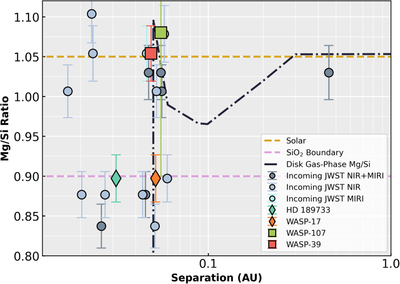
Caption: Figure 4.
Mg/Si ratios of JWST-observed hot Jupiter host stars vs. separation (semimajor axis). Mg/Si ratios compiled from J. M. Brewer et al. (2016) with an error of 3.3% as quoted in J. M. Brewer & D. A. Fischer (2016) as well as N. Hejazi et al. (2023). Diamond markers indicate systems in which the hot Jupiter companion is reported to have spectral signatures of SiO2(s) clouds. Square markers indicate no current robust detection for a particular silicate species. The purple dashed line indicates the Mg/Si ratio point that distinguishes the onset of either forsterite (>0.9) or quartz (<0.9) condensates (E. Calamari et al. 2024). The navy dashed line indicates the theoretical gas-phase Mg/Si ratio in a solar-type disk from A. Thiabaud et al. (2015).
Other Images in This Article
Copyright and Terms & Conditions
© 2026. The Author(s). Published by the American Astronomical Society.

