

Image Details
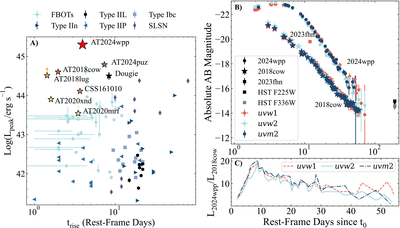
Caption: Figure 4.
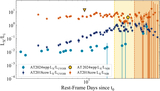
AT 2024wpp is the most luminous LFBOT discovered to date. (a) AT 2024wpp in the phase space of peak bolometric luminosity vs. rise time (rest frame) for FBOTs and other transients. Colored (grayscale) stars represent LFBOTs (likely LFBOTs). References: AT 2018cow (R. Margutti et al. 2019; D. A. Perley et al. 2019), CSS 161010 (C. P. Gutiérrez et al. 2024), AT 2018lug (A. Y. Q. Ho et al. 2020), AT 2020xnd (D. A. Perley et al. 2021), AT 2020mrf (Y. Yao et al. 2022), Dougie (J. Vinkó et al. 2015), AT 2024puz (J. J. Somalwar et al. 2025), FBOTs (M. R. Drout et al. 2014; I. Arcavi et al. 2016; M. Pursiainen et al. 2018), SNe Ibc (M. W. Richmond et al. 1996; P. A. Mazzali et al. 2000; F. Patat et al. 2001; M. Stritzinger et al. 2002; Y. Yoshii et al. 2003; P. Ferrero et al. 2006; P. A. Mazzali et al. 2006; S. Taubenberger et al. 2006; S. Valenti et al. 2008; D. J. Hunter et al. 2009; M. Modjaz et al. 2009; G. Pignata et al. 2011; S. Valenti et al. 2011), SLSNe (R. M. Quimby et al. 2011; C. Inserra et al. 2013), SNe IIP (M. Hamuy 2003), SNe IIn (M. Kiewe et al. 2012; R. Margutti et al. 2014), SNe IIL (I. Arcavi et al. 2012). We calculate peak pseudobolometric luminosities of LFBOTs AT 2018lug, AT2020xnd, and AT2020mrf using their peak g-band magnitudes (i.e., ﹩{L}_{{\rm{pk}}}={\nu }_{g}{L}_{{\rm{pk}},{\nu }_{g}}﹩). For FBOTs, SLSNe, and some SNe Ib/c, we similarly plot pseudobolometric luminosities. (b) Comparison of the three best-sampled LFBOTs in the UV (extinction-corrected, host-subtracted absolute magnitudes). For AT 2023fhn, we report the HST results from A. A. Chrimes et al. (2024a) for aperture photometry performed using a 0﹩\mathop{.}\limits^{\unicode{x02033}}﹩4 annulus background and an extinction-corrected Swift w1 observation (see Appendix A for reduction details). Swift UVOT observations of AT 2024wpp captured the rise of an LFBOT and the evolution of an LFBOT at δt ≳ 60 d for the first time at UV wavelengths. (c) AT 2024wpp is ∼4.5 times more UV-luminous than the prototypical event AT 2018cow at peak, and it is the most UV-luminous FBOT discovered to date.
Other Images in This Article
Show More
Copyright and Terms & Conditions
© 2026. The Author(s). Published by the American Astronomical Society.

