Image Details

Choose export citation format:

The Most Luminous Known Fast Blue Optical Transient AT 2024wpp: Unprecedented Evolution and Properties in the Ultraviolet to the Near-infrared

  • Authors: Natalie LeBaron, Raffaella Margutti, Ryan Chornock, Nayana A. J., Olivia Aspegren, Wenbin Lu, Brian D. Metzger, Daniel Kasen, Thomas G. Brink, Sergio Campana, Paolo D'Avanzo, Jakob T. Faber, Matteo Ferro, Alexei V. Filippenko, Ryan J. Foley, Xinze Guo, Erica Hammerstein, Saurabh W. Jha, Charles D. Kilpatrick, Giulia Migliori, Dan Milisavljevic, Kishore C. Patra, Huei Sears, Jonathan J. Swift, Samaporn Tinyanont, Vikram Ravi, Yuhan Yao, Kate D. Alexander, Prasiddha Arunachalam, Edo Berger, Joe S. Bright, Chuck Cynamon, Kyle W. Davis, Braden Garretson, Puragra Guhathakurta, Wynn V. Jacobson-Galán, D. O. Jones, Ravjit Kaur, Stefan Kimura, Tanmoy Laskar, Morgan Nuñez, Michaela Schwab, Monika D. Soraisam, Nao Suzuki, Kirsty Taggart, Eli Wiston, Yi Yang, WeiKang Zheng

Natalie LeBaron et al 2026 The Astrophysical Journal Letters 997 .

  • Provider: AAS Journals

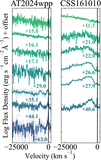
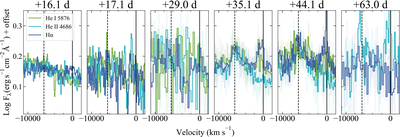
Caption: Figure 6.

By +35 days, AT 2024wpp shows the emergence of clear Hα and He features blueshifted by ∼6400 km s−1(dashed black line). The FWHM values of the blueshifted features stay consistently near ∼2000 km s−1 over the final three epochs. A blend of narrow host galaxy emission and a slightly broader spectral feature base from AT 2024wpp are also evident at 0 km s−1, especially for Hα and He I. We do not identify a He I feature in the +63-day spectrum and thus omit that wavelength region for visual clarity. The lightly shaded spectra indicate native binning.

Other Images in This Article
Show More

Copyright and Terms & Conditions

Additional terms of reuse