Image Details

Choose export citation format:

The Most Luminous Known Fast Blue Optical Transient AT 2024wpp: Unprecedented Evolution and Properties in the Ultraviolet to the Near-infrared

  • Authors: Natalie LeBaron, Raffaella Margutti, Ryan Chornock, Nayana A. J., Olivia Aspegren, Wenbin Lu, Brian D. Metzger, Daniel Kasen, Thomas G. Brink, Sergio Campana, Paolo D'Avanzo, Jakob T. Faber, Matteo Ferro, Alexei V. Filippenko, Ryan J. Foley, Xinze Guo, Erica Hammerstein, Saurabh W. Jha, Charles D. Kilpatrick, Giulia Migliori, Dan Milisavljevic, Kishore C. Patra, Huei Sears, Jonathan J. Swift, Samaporn Tinyanont, Vikram Ravi, Yuhan Yao, Kate D. Alexander, Prasiddha Arunachalam, Edo Berger, Joe S. Bright, Chuck Cynamon, Kyle W. Davis, Braden Garretson, Puragra Guhathakurta, Wynn V. Jacobson-Galán, D. O. Jones, Ravjit Kaur, Stefan Kimura, Tanmoy Laskar, Morgan Nuñez, Michaela Schwab, Monika D. Soraisam, Nao Suzuki, Kirsty Taggart, Eli Wiston, Yi Yang, WeiKang Zheng

Natalie LeBaron et al 2026 The Astrophysical Journal Letters 997 .

  • Provider: AAS Journals

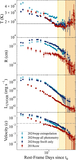
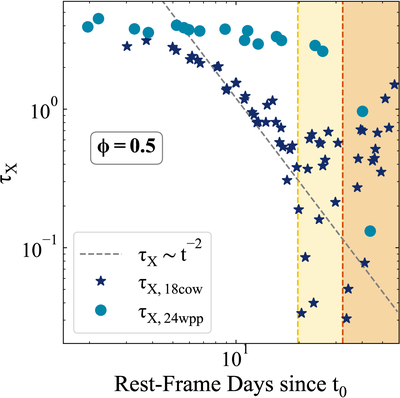
Caption: Figure 10.

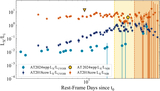
Assuming that the observed LUVOIR is purely due to radiative processing of X-rays (B. D. Metzger 2022a) occurring within (an arbitrary) 50% of the solid angle (parameterized by ϕ; in the other half, we assume that all X-rays are reprocessed), we calculate the associated τX for AT 2024wpp (circles) and AT 2018cow (stars) over time and compare to the time of emergence of spectral features (vertical dashed lines; same as Figure 9) for each object. The gray dashed line represents the canonical scaling (τX ∝ t−2) for radiation escaping a medium expanding at constant velocity. We find that AT 2024wpp maintains a higher τX for longer compared to AT 2018cow. This is consistent with the features of AT 2024wpp emerging at a later epoch and with the larger inferred Mej (Section 3).

Other Images in This Article
Show More

Copyright and Terms & Conditions

Additional terms of reuse