

Image Details
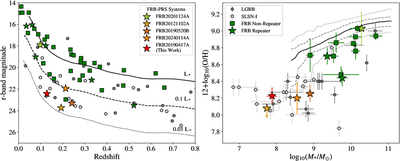
Caption: Figure 3.
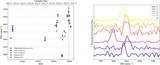
The host galaxy of FRB 20190417A in the context of other FRBs and energetic transients. The known FRB–PRS systems (listed in Table 2) are shown as colored stars, while other FRB hosts are shown as green stars and squares (for repeaters and nonrepeaters, respectively). Left: host galaxy apparent r-band magnitude vs. redshift. Information for FRB hosts was taken from A. C. Gordon et al. (2024) and references therein. For comparison, we also show a set of SLSN-I (pentagons) and LGRB (circles) host galaxies from R. Lunnan et al. (2014) and K. M. Svensson et al. (2010). The host galaxies of the FRB–PRS systems are notable in that, with the exception of FRB 20201124A, they are all fainter than 0.1 L* galaxies. Right: galaxy stellar mass vs. gas-phase metallicity. Black lines represent the median, 68%, and 95% contours for Sloan Digital Sky Survey star-forming galaxies from C. A. Tremonti et al. (2004). FRB host galaxy information is taken from K. E. Heintz et al. (2020), S. Bhandari et al. (2022), and M. Bhardwaj et al. (2021); SLSN-I, from R. Lunnan et al. (2014); and LGRB, from E. M. Levesque et al. (2010). The metallicity for the SLSNe-I and LGRBs was measured using either an O3N2 diagnostic (A. S. Hirschauer et al. 2018) or an R23 diagnostic (H. A. Kobulnicky & L. J. Kewley 2004). To compare our PP04 N2 measurement from Section 3.4.2, we convert to R23 using the equations from L. J. Kewley & S. L. Ellison (2008). The host galaxies of the FRB–PRS systems are again notable: they have low masses and metallicities, more comparable to those of SLSN-I and LGRB hosts.
Other Images in This Article
Copyright and Terms & Conditions
© 2025. The Author(s). Published by the American Astronomical Society.

