

Image Details
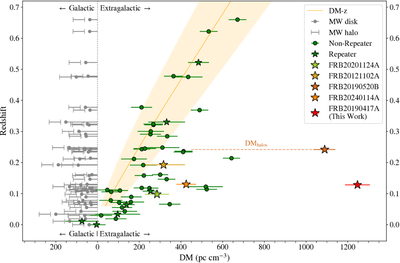
Caption: Figure 4.
Figure 3 from C. H. Niu et al. (2022) updated to include 51 FRBs with robust (PPATH > 0.9) host associations and redshifts (C. J. Law et al. 2024; CHIME/FRB Collaboration et al. 2025). Galactic disk contributions are estimated from NE2001 with ±20% uncertainties, along with an additional halo contribution of 25–80 pc cm−3. The red error bars on each extragalactic DM estimate represent a conservative full range uncertainty encompassing the Galactic disk and halo ranges. The expected median DM contribution of the IGM and the inner 1σ confidence interval are given by the orange line and shaded region, respectively. The known PRS-associated FRBs are shown as colored stars, while other FRBs are shown as green stars and squares (for repeaters and nonrepeaters, respectively). FRB 20190520B intersects an exceptional LOS (K.-G. Lee et al. 2023); we include its estimated DMhalos contribution for reference.
Other Images in This Article
Copyright and Terms & Conditions
© 2025. The Author(s). Published by the American Astronomical Society.

