Image Details

Choose export citation format:

A Milliarcsecond Localization Associates FRB 20190417A with a Compact Persistent Radio Source and an Extreme Magnetoionic Environment

  • Authors: Alexandra M. Moroianu, Shivani Bhandari, Maria R. Drout, Jason W. T. Hessels, Danté M. Hewitt, Franz Kirsten, Benito Marcote, Ziggy Pleunis, Mark P. Snelders, Navin Sridhar, Uwe Bach, Emmanuel K. Bempong-Manful, Vladislavs Bezrukovs, Richard Blaauw, Justin D. Bray, Salvatore Buttaccio, Shami Chatterjee, Alessandro Corongiu, Roman Feiler, B. M. Gaensler, Marcin P. Gawroński, Marcello Giroletti, Adaeze L. Ibik, Ramesh Karuppusamy, Mattias Lazda, Calvin Leung, Michael Lindqvist, Kiyoshi W. Masui, Daniele Michilli, Kenzie Nimmo, Omar S. Ould-Boukattine, Ayush Pandhi, Zsolt Paragi, Aaron B. Pearlman, Weronika Puchalska, Paul Scholz, Kaitlyn Shin, Jurjen J. Sluman, Matteo Trudu, David Williams-Baldwin, Jun Yang

Alexandra M. Moroianu et al 2026 The Astrophysical Journal Letters 996 .

  • Provider: AAS Journals

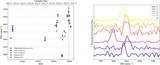
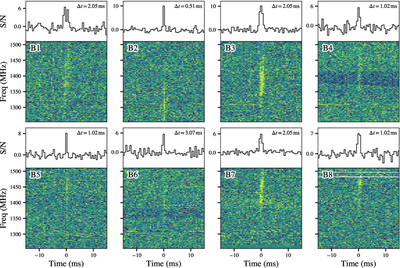
Caption: Figure 5.

Temporal profiles (top) and dynamic spectra (bottom) of the eight FRB 20190417A bursts detected with the Ef radio telescope. Each burst is coherently dedispersed to a DM of 1379.0 pc cm−3 and is shown with a frequency resolution of 1 MHz; the time resolutions are shown in the upper right corners of each panel. Horizontal white bands correspond to frequency channels that have been flagged owing to RFI. The limits of the color map have been set to the 20th and 98th percentiles of each dynamic spectrum. We note that some of the wider bursts appear slightly over-dedispersed; future work will analyze all bursts at a higher time resolution to place tighter constraints on their DM.

Other Images in This Article
Copyright and Terms & Conditions

Additional terms of reuse