

Image Details
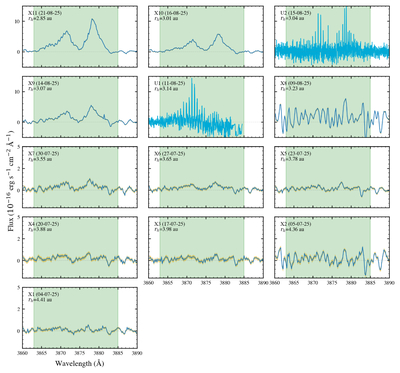
Caption: Figure 2.
Continuum-subtracted spectra of 3I/ATLAS in the CN B2Σ+–X2Σ+(0–0) violet band region (3860–3890 Å) from a monitoring campaign spanning 2025 July 4–August 21. The grid displays 11 X-Shooter spectra (X1–X11) and two high-resolution UVES observations (U1 and U2), arranged by decreasing heliocentric distance, from top left to bottom right. Each panel indicates the observation date and heliocentric distance rh (in astronomical units). CN emission is first detected in visit X6 (2025 July 27, rh = 3.65 au) and increases in strength as the comet approaches the Sun. The green shaded region marks the CN-band feature. UVES spectra show finer spectral structure compared to the lower-resolution X-Shooter observations. The shaded regions represent 1σ uncertainties.
Other Images in This Article
Copyright and Terms & Conditions
© 2025. The Author(s). Published by the American Astronomical Society.

