

Image Details
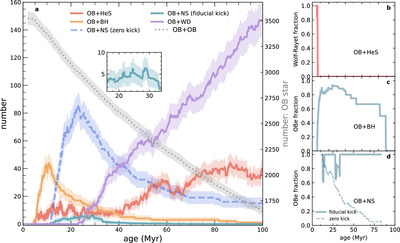
Caption: Figure 3.
Panel (a): predicted numbers of postinteraction binaries as a function of age in a coeval stellar population with a total mass of 1.3 × 10⁵ M ⊙. The solid lines in reddish brown, orange, turquoise, and purple represent binaries with an OB star paired with a helium-burning star, BH, NS, and WD component, respectively, under the fiducial assumptions. The dashed blue line denotes the number of OB+NS binaries without including SN kicks. Additionally, we depict the number of OB+OB binaries with m F814W ≤ 20 with the dotted gray line, referring to the scale on the right y-axis for its values. The shaded areas show one standard deviation of the Poisson distribution. The inset provides a zoomed-in view of the results for OB+NS binaries, assuming fiducial kicks. Panel (b): fraction of W-R stars, which are identified according to the criterion in T. Shenar et al. (2020a), among helium-burning stars with OB companions. Panel (c): fraction of OBe stars among OB+BH binaries. Here, we treat stellar models whose surface rotational velocities are higher than 95% of their breakup values as OBe stars. Panel (d): fraction of OBe stars among OB+NS binaries. The solid and dashed lines correspond to results for OB+NS binaries with and without SN kicks.
Other Images in This Article
Show More
Copyright and Terms & Conditions
© 2024. The Author(s). Published by the American Astronomical Society.

