

Image Details
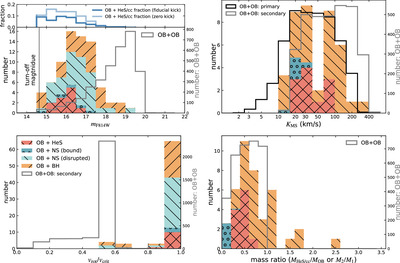
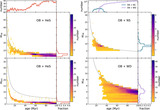
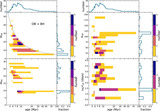
Caption: Figure 2.
Predicted properties of OB-type MS star binaries containing a helium-burning star (reddish brown bars), an NS that remains bound after SN kicks (turquoise bars with circles), an NS that is kicked out of the binary during SN explosion (cyan bars with diagonal lines), or a BH (orange bars) at 15 Myr. In the second and fourth panels, we exclude disrupted binaries to focus on binary features. The first panel displays the number distribution as a function of magnitude in terms of the HST/WFC3 F814W band. The gray open bars denote binaries containing two OB-type MS stars, with values on the right y-axis. The vertical dashed line marks the cluster turnoff magnitude. The upper panel shows the fraction of evolved massive binaries relative to the total number of stellar models at corresponding magnitudes with (dark) and without (light) SN kicks. The second panel shows the semiamplitude orbital velocity distribution of the OB star within evolved binaries and OB+OB systems. The third panel illustrates the velocity distribution of OB star components in evolved massive binaries. Open gray bars denote the rotational velocities of the secondary stars in OB+OB binaries, shown on the right y-axis. The fourth panel presents the mass ratio distribution. For evolved massive binaries, the mass ratio is defined as the ratio of the post-MS component’s mass to the OB component’s mass. For OB+OB binaries, it is the ratio of the secondary star’s mass to the primary star’s mass.
Other Images in This Article
Show More
Copyright and Terms & Conditions
© 2024. The Author(s). Published by the American Astronomical Society.

