

Image Details
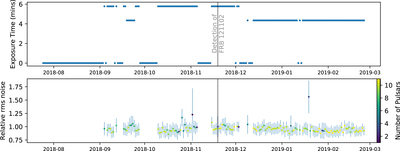
Caption: Figure 1.
Timeline of CHIME/FRB’s daily exposure to FRB 121102 within the FWHM of the telescope’s synthesized beams at 600 MHz. The reduction in daily exposure starting 2018 December 7 is due to the failure of the computing node responsible for processing one of the four FFT-formed beams through which the source transits. The rms noise is estimated relative to that for the day of detection of the FRB 121102 burst using pulsars detected by CHIME/FRB with the marker colors denoting the number of pulsars used for the estimate. The errors on the relative rms noise account only for the day-to-day sensitivity variation and are not representative of the overall error on the fluence threshold. See Section 2.5 for a description of how the fluence threshold and the corresponding error were determined.
Other Images in This Article
Copyright and Terms & Conditions
© 2019. The American Astronomical Society. All rights reserved.

