

Image Details
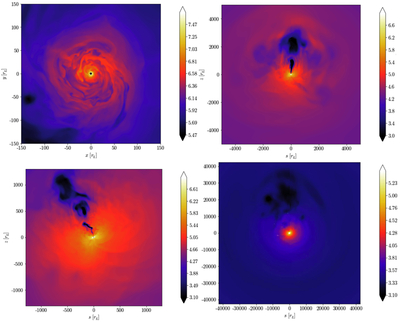
Caption: Figure 6.
Planar slices of the logarithmic mass density in g cm−3 at different times. Top left: the equatorial plane at t − tdisk ≈ 0.11 s, shortly after the high-density accretion disk forms. Top right: the meridional plane, demonstrating that the disk has accumulated sufficient poloidal magnetic flux to launch a relativistic jet (black) perpendicular to the disk plane. The low-density cavities visible in multiple directions trace the activity of misaligned jets that are subsequently choked by the onslaught of infalling gas. As these outflows are quenched by the ram pressure of the accretion flow, the disk becomes embedded in gas with stochastic angular momentum, leading to a continuous disk tilt. Bottom left: the subsequent launching of a misaligned jet at t − tdisk ≈ 0.61 s. Bottom right: a large-scale view from the final snapshot of the simulation at t − tdisk ≈ 0.78, s ≈ 3.8 × 10⁶ rg/c, when the jet-driven shock has propagated to ∼4 × 10⁴ rg ≈ 2400 km.
Other Images in This Article
Copyright and Terms & Conditions
© 2026. The Author(s). Published by the American Astronomical Society.

