

Image Details
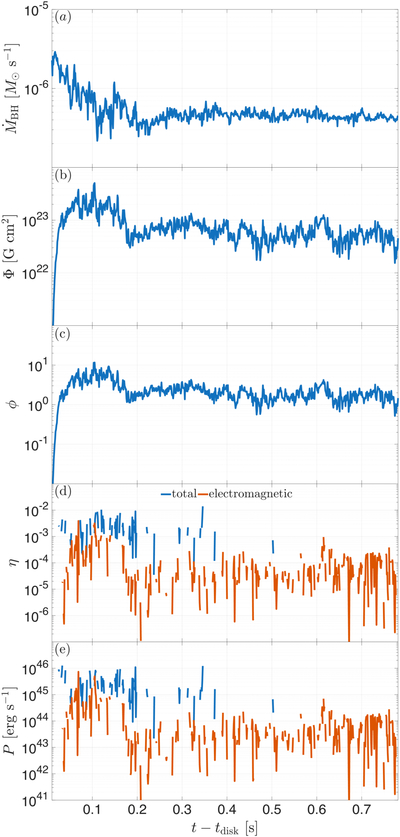
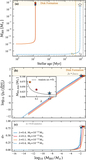
Caption: Figure 5.
(a) The mass accretion rate initially declines as ﹩{\dot{M}}_{{\rm{BH}}}\sim {t}^{-0.7}﹩ due to the formation of the compression shock. Once the flow relaxes, the accretion rate transitions to a plateau, consistent with expectations for freely infalling gas. (b), (c) The magnetic flux, Φ, and dimensionless magnetic flux, ϕ, exhibit an early overshoot as the toroidal field accumulates in the disk, after which both quantities relax onto a plateau. (d) Hydrodynamic winds launched from the disk tap a fraction of the accretion power and contribute significantly to the total feedback efficiency (blue). Because the disk field is still predominantly toroidal, electromagnetic outflows (red) remain inefficient at this stage. (e) Consequently, the early outflows are dominated by hydrodynamic winds, which exceed the electromagnetic contributions. The segmented appearance of the power curves is a plotting effect: the signed launching power is shown on a logarithmic scale, so intervals in which the net power becomes negative are not displayed.
Other Images in This Article
Copyright and Terms & Conditions
© 2026. The Author(s). Published by the American Astronomical Society.

