

Image Details
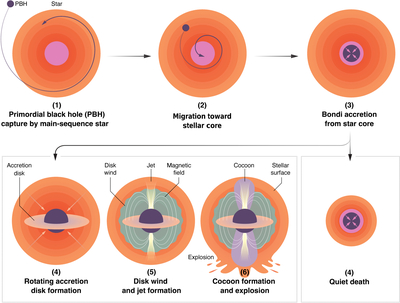
Caption: Figure 1.
A schematic illustration (not to scale) of the evolutionary sequence of a Hawking star. An initially unbound PBH is first captured onto a bound, star-crossing orbit through three-body interactions, such as planetary slingshots in a stellar system with a binary companion, and subsequently migrates toward the stellar core through repeated dissipative transits (stages 1–2; see Sections 2 and 3). Once embedded in the core, the PBH grows through quasi-spherical Bondi accretion with low radiative efficiency (stage 3; see Section 4; and M. Cantiello et al. 2026). The subsequent fate depends on whether the PBH reaches the disk-formation threshold before consuming the host (see Section 6). If sufficient angular momentum is available when the PBH reaches the formal disk-formation mass, a rotationally supported accretion disk forms (explosive branch—stage 4 on the left; see Section 5). Magnetic flux is subsequently generated in the disk, powering disk winds and PBH-driven jets (stage 5; see Section 7), which inflate a hot cocoon and deposit energy into the stellar interior. This feedback ultimately disrupts the host star in an energetic explosion on timescales far shorter than its main-sequence lifetime (stage 6; see Section 8). If, instead, the PBH is deposited after substantial stellar spin-down, or if its growth is sufficiently slow that disk formation is delayed until the stellar angular momentum has declined, the formal disk threshold may lie above the available stellar mass. In this quiet branch, the PBH consumes the star before an explosive disk forms, leaving a stellar-mass BH without a bright disk-powered transient.
Other Images in This Article
Copyright and Terms & Conditions
© 2026. The Author(s). Published by the American Astronomical Society.

