

Image Details
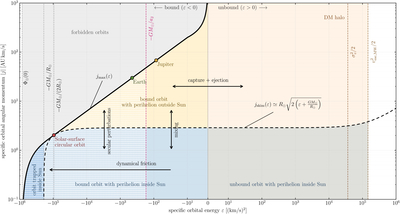
Caption: Figure 2.
A phase-space diagram of orbits in the solar system (SS), in the plane of specific orbital energy ε (symmetric log, linear for ∣ε∣ < 10 km2 s−2) and specific orbital angular momentum ∣j∣ (log). The solid black curve is the maximum angular momentum ﹩{j}_{{\rm{\max }}}(\varepsilon )﹩ at a fixed ε, attained by a circular orbit; orbits above are kinematically forbidden (gray). The dashed black curve is the locus ﹩{j}_{{\rm{skim}}}(\varepsilon )\approx {R}_{\odot }\sqrt{2(\varepsilon +G{M}_{\odot }/{R}_{\odot })}﹩ where the perihelion (aphelion) skims the solar surface at ε > −GM⊙/R⊙ (ε < −GM⊙/R⊙). The light blue region below (tan region above) the dashed curve corresponds to orbits whose perihelion lies inside (outside) the Sun, while the dark blue region represents orbits entirely contained in the Sun. Bound phase space in the outer SS at −GM⊙/aJ < ε < 0 (right of the vertical pink-dashed line) is in detailed balance with the unbound “bath” of the DM halo (orange region) through Jovian slingshots (capture and ejection) of low-kinetic energy DM orbits much below the typical value of ﹩\varepsilon \sim {\sigma }_{v}^{2}/2﹩ and maximum value ﹩{v}_{{\rm{esc}},{\rm{MW}}}^{2}/2﹩. Angular-momentum changes are rapid due to chaotic phase-space mixing from secular perturbations and close planetary encounters. The phase space in the inner SS (left of pink line, polka dots) is sparsely populated by slow energy loss from dynamical friction, which occurs only for Sun-crossing orbits ﹩| j| \lt {j}_{{\rm{skim}}}(\varepsilon )﹩, along with some diffusion due to gravitational scattering with minor planets. Eventually, dynamical friction would drain enough energy to deposit the PBH at the solar core with ε = Φ0(0) and j = 0. Reference orbits at Earth’s and Jupiter’s semimajor axes are marked.
Other Images in This Article
Copyright and Terms & Conditions
© 2026. The Author(s). Published by the American Astronomical Society.

