

Image Details
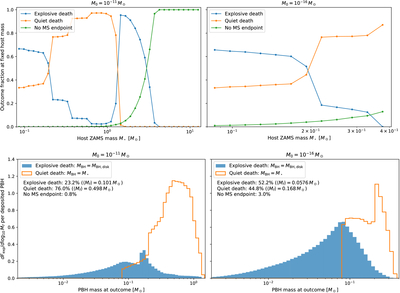
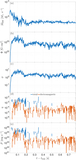
Caption: Figure 3.
Monte Carlo population outcomes for two initial PBH masses, M0 = 10−11 M⊙ (left columns), representative of the massive-seed, short-growth-lag limit where tlag ≪ tMS, and M0 = 10−16 M⊙ (right columns), representative of the long-lag regime near the minimum seed masses capable of reaching a main-sequence endpoint. Systems are classified as explosive if the disk-formation threshold is reached before the PBH consumes the host, MBH,disk < M⋆ and td < t⋆. Systems for which the PBH consumes the star before an explosive disk forms are classified as quiet deaths, while systems that reach neither endpoint before the end of the modeled main-sequence window are labeled no main-sequence (MS) endpoint. Top panels: the outcome fractions as a function of host ZAMS mass. The lower-M0 channel is more strongly filtered by growth time, stellar spin-down, and companion-delivery requirements, resulting in a limited host-mass range. Bottom panels: the capture-weighted PBH mass distribution at the terminal outcome. Explosive deaths are assigned Mf ≈ MBH,disk with the median 〈Mf〉 ≲ 0.1 M⊙, while quiet deaths are assigned Mf ≈ M⋆. The histograms are normalized per deposited PBH, so the area under each component gives the corresponding outcome fraction. Accordingly, the two columns compare conditional outcomes at a fixed M0. Their relative cosmic occurrence additionally depends on the PBH mass function and the underlying companion and host-star populations.
Other Images in This Article
Copyright and Terms & Conditions
© 2026. The Author(s). Published by the American Astronomical Society.

