

Image Details
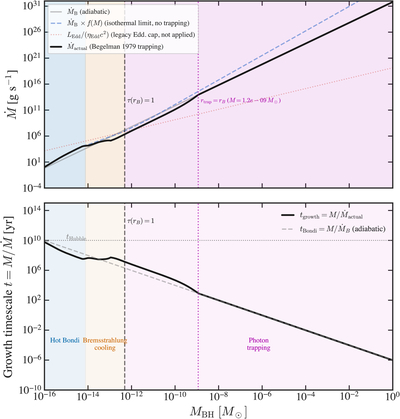
Caption: Figure 8.
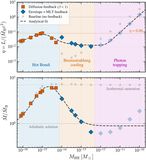
Top panel: accretion rate onto a PBH in the solar core as a function of BH mass. The gray solid line shows the adiabatic Bondi rate ﹩{\dot{M}}_{{\rm{B}}}\propto {M}^{2}﹩; the blue dashed line shows the isothermal-limit cooling-enhanced rate ﹩f(M){\dot{M}}_{{\rm{B}}}﹩; the red dotted line shows the legacy Eddington cap LEdd/(ηEddc2) with ηEdd = 0.01 for reference (not applied in our prescription); and the thick black line shows the physical accretion rate of Equation (9), which incorporates the M. C. Begelman (1979) photon-trapping framework and the effective-gravity reduction from the escaping luminosity. Vertical markers indicate the onset of trapping at τ(rB) = 1 (gray dashed line) and the full-trapping mass (rtrap = rB, magenta dotted line; an internal landmark, not a regime boundary); both lines are repeated in the two panels. Colored bands indicate the three spherical-accretion regimes. Bottom panel: corresponding growth timescale ﹩t=M/\dot{M}﹩. The Hubble time is marked as a horizontal dotted line. The growth time decreases monotonically with mass throughout the spherical regime (other than a small bump at MBH ∼ 10−14 M⊙ in the transition from the hot Bondi to bremsstrahlung-cooling regime); the partial-trapping window introduces only a smooth O(1) reduction relative to adiabatic Bondi growth, with no Salpeter plateau.
Other Images in This Article
Copyright and Terms & Conditions
© 2026. The Author(s). Published by the American Astronomical Society.

