

Image Details
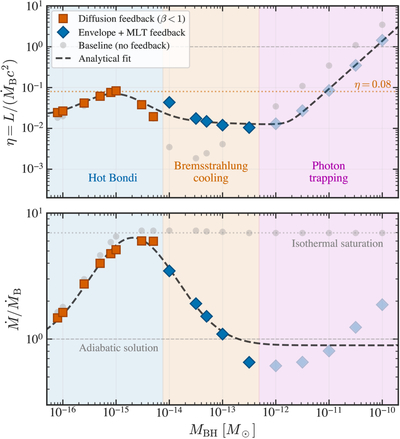
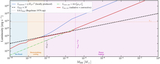
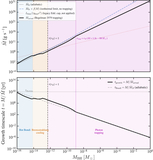
Caption: Figure 5.
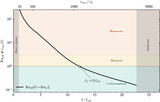
Top: radiative efficiency ﹩\eta =L/({\dot{M}}_{{\rm{B}}}{c}^{2})﹩, normalized to the adiabatic Bondi rate (Section 3.2), as a function of PBH mass. Bottom: accretion-rate enhancement ﹩\dot{M}/{\dot{M}}_{{\rm{B}}}﹩ over the adiabatic Bondi rate. Vermillion squares show diffusion-feedback results (where β < 1), blue diamonds show envelope + MLT feedback results, and gray circles show the baseline (no-feedback) runs. Dashed black curves show the analytical fits (Equations (A1) and (A2)). The horizontal orange dotted line in the top panel marks η = 0.08 assumed by E. P. Bellinger et al. (2023), and the thin horizontal gray dashed line marks η = 1, the upper bound on the radiative efficiency; our self-consistent efficiency is ∼1 order of magnitude lower across the optically thin regime. Background shading indicates the three spherical-accretion regimes: hot Bondi (blue), bremsstrahlung cooling (orange), and photon trapping (purple). In the photon-trapping regime (MBH ≳ 5 × 10⁻¹³ M⊙), the plotted η values are the locally emitted efficiency from the optically thin Bondi + cooling solution; they overestimate the externally observed efficiency, which is capped by Lesc ≲ 0.6LEdd (M. C. Begelman 1979). Equation (9) uses these values together with the effective-gravity reduction ﹩{(1-{L}_{{\rm{esc}}}/{L}_{{\rm{Edd}}})}^{2}﹩ to compute the physical accretion rate.
Other Images in This Article
Copyright and Terms & Conditions
© 2026. The Author(s). Published by the American Astronomical Society.

