

Image Details
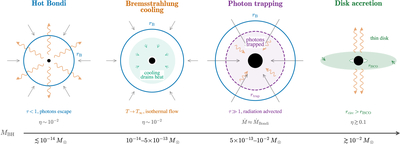
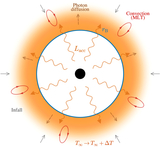
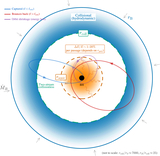
Caption: Figure 6.
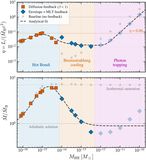
Schematic overview of the three spherical-accretion regimes and the disk-accretion regime onto a PBH embedded in a stellar interior, ordered by increasing MBH. Hot Bondi (MBH ≲ 10−14 M⊙): the Bondi sphere is optically thin (τ < 1); bremsstrahlung photons (orange wavy arrows) escape freely without interacting with the infalling gas (gray arrows), yielding η ≈ 0.01–0.1, peaking near 10−15 M⊙. Bremsstrahlung cooling (10−14–5 × 10⁻¹³ M⊙): bremsstrahlung cooling (green region) drains thermal energy before the gas reaches pair-producing temperatures; the flow approaches isothermal (T → T∞) and η ≈ 10−2. Photon trapping (5 × 10⁻¹³ ≲ MBH/M⊙ ≲ 10−2): the Bondi sphere is optically thick; in spherical geometry the trapping radius rtrap moves outward from rS and most locally produced photons are advected inward rather than escaping (M. C. Begelman 1979). The escaping luminosity is bounded by ∼0.6LEdd but does not cap the accretion rate, and ﹩\dot{M}\approx {\dot{M}}_{{\rm{B}}}﹩ throughout. Disk accretion (MBH ≳ 10−2 M⊙, depending on stellar rotation): once rcirc > rISCO a thin disk forms, η ≈ 0.08, and the standard Eddington limit applies via viscous angular-momentum transport (O. Gottlieb et al. 2026).
Other Images in This Article
Copyright and Terms & Conditions
© 2026. The Author(s). Published by the American Astronomical Society.

