

Image Details
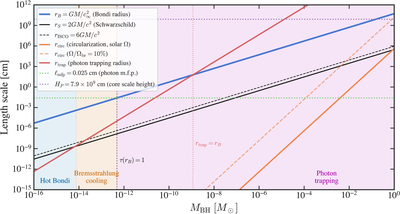
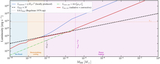
Caption: Figure 1.
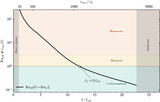
Physical length scales controlling the accretion regime as a function of PBH mass, for solar-core conditions. The Bondi radius rB (blue) defines the gravitational sphere of influence. The vertical dotted line marks τ(rB) = 1, where the Bondi sphere becomes optically thick (M ∼ 5 × 10⁻¹³ M⊙). The photon-trapping radius rtrap (red) exceeds rB at M ∼ 10−9 M⊙. Two circularization radii rcirc (orange) are shown: one for the present-day solar-core rotation (Ω/Ωbr ≈ 5 × 10⁻⁴, solid) and one for 10% of the core breakup frequency ﹩{{\rm{\Omega }}}_{{\rm{br}}}=\sqrt{G{M}_{{\rm{core}}}/{r}_{{\rm{core}}}^{3}}\approx 5.3\times 1{0}^{-3}﹩ rad s−1 (dashed). An accretion disk forms where rcirc crosses rISCO (black dashed). Young solar-type stars rotate significantly faster than the present Sun, so disk formation may occur at lower BH masses during the early evolution. Colored bands denote the three spherical-accretion regimes discussed in Section 3.1; the onset of trapping at τ(rB) = 1 marks the boundary into the photon-trapping regime. The two horizontal dotted lines mark the photon mean free path in the unperturbed solar core, ℓmfp = 1/(neσT) ≈ 0.025 cm (green), and the pressure scale height of the solar core, HP ≈ 7.9 × 109 cm (purple), above which the ambient stellar stratification becomes relevant.
Other Images in This Article
Copyright and Terms & Conditions
© 2026. The Author(s). Published by the American Astronomical Society.

