

Image Details
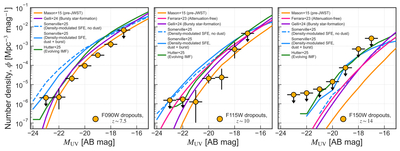
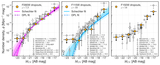
Caption: Figure 9.
A comparison of the number densities measured from BEACON DR2 (orange scatter points) for, respectively, the F090W dropouts (z ∼ 7.5), the F115W dropouts (z ∼ 10), and the F150W dropouts (z ∼ 14) with various theoretical models at similar redshifts (from left to right, z = 8, 10, and 14). We plot an analytical pre-JWST model by C. A. Mason et al. (2015a, orange), implementing mass-dependent but redshift-independent SFE, an attenuation-free model by A. Ferrara et al. (2023, pink), a model implementing halo-mass-dependent stochasticity by V. Gelli et al. (2024, violet), a density-modulated SFE model by R. S. Somerville et al. (2025)—including a version with no dust (dashed blue), and a version incorporating dust and starbursts (solid blue), and a model with an evolving IMF by A. Hutter et al. (2025, green).
Other Images in This Article
Copyright and Terms & Conditions
© 2026. The Author(s). Published by the American Astronomical Society.

