

Image Details
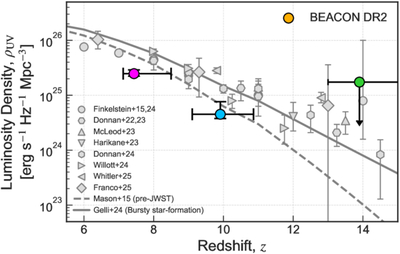
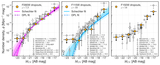
Caption: Figure 8.
The cosmic UV luminosity density, ρUV, resulting from integrating our best-fit Schechter function UV LFs down to MUV = −17 (colored points). The errors on the luminosity density are estimated as the 16th and 84th percentiles of the ρUV values. The redshift error corresponds to the 16th and 84th percentiles of the best-fit EAZY redshift for the galaxy candidates included in the given sample (i.e., F090W or F115W dropouts). For the F150W selection, where the LF is unconstrained, we instead show an upper limit on ρUV derived from integrating the binned upper limits of the LF over the range −23 < MUV < −17. For comparison, we show observational constraints from HST by S. L. Finkelstein et al. (2015) and from other JWST studies (C. T. Donnan et al. 2022, 2024; Y. Harikane et al. 2023; D. J. McLeod et al. 2024; S. L. Finkelstein et al. 2024; C. J. Willott et al. 2024; M. Franco et al. 2025; L. Whitler et al. 2025). We also show predictions from theoretical models by C. A. Mason et al. (2015a) and V. Gelli et al. (2024).
Other Images in This Article
Copyright and Terms & Conditions
© 2026. The Author(s). Published by the American Astronomical Society.

