

Image Details
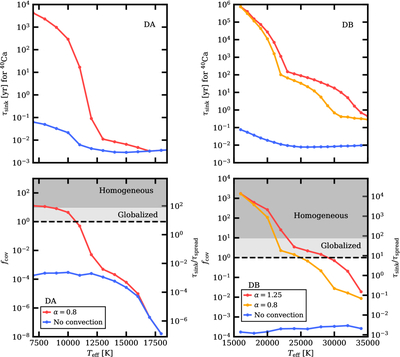
Caption: Figure 8.
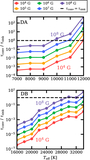
Top left: sinking timescales of 40Ca on a hydrogen-atmosphere white dwarf (0.6 M⊙, ﹩{\mathrm{log}}\,g=8﹩, abbreviated as DA) calculated by MESA. Two cases are simulated—full convection with ML2/α = 0.8 and no convection. The latter case represents the limit where the magnetic field significantly affects the base of the convection zone. The α = 0.8 curve corresponds to the fiducial mixing length value used in the MESA prescription of E. B. Bauer & L. Bildsten (2019). Bottom left: the pollution gradient parameter fcov (Equation (28)) or the timescale ratio τsink/τspread. The horizontal diffusion coefficient Dsurf is taken from the 3D radiation hydrodynamics code CO5BOLD (T. Cunningham et al. 2021), which is then used to calculate τspread with Equation (27). When fcov is of order unity, the pollution spot can spread over the entire white dwarf surface, but there is still a strong pollution gradient. Homogeneous pollution can be possible when fcov ≪ 1. The two shaded regions with their corresponding labels show these two global and homogeneous pollution limits. Partial convection may be possible (Section 4.3), resulting in covering fractions between the convective and nonconvective limits shown in this figure. Right: same as the left panels except now calculated for a helium-atmosphere white dwarf (﹩{\mathrm{log}}\,g=8﹩, abbreviated as DB). Three cases are simulated—convection with ML2/α = 1.25 (D. Koester et al. 2020), convection with ML2/α = 0.8 (E. Cukanovaite et al. 2019), and no convection. Note that the vertical scales differ for all four panels.
Other Images in This Article
Copyright and Terms & Conditions
© 2026. The Author(s). Published by the American Astronomical Society.

