

Image Details
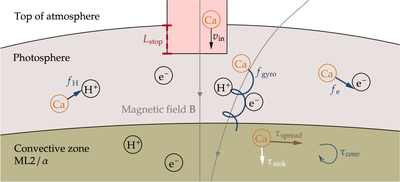
Caption: Figure 6.
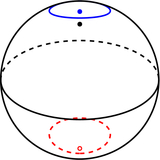
Diagram illustrating a DA (hydrogen-dominated) white dwarf’s atmospheric structure and dynamics of incoming polluting 40Ca ions. Initially, the incoming particle arrived at the top of the atmosphere with velocity vin, punching through the atmosphere with length Lstop, which is a small fraction of the atmospheric pressure scale height. Within the atmosphere, the particle’s motion can be affected by collisions with atmospheric electrons and ions (characterized by frequencies fe and fH for collisions with electrons and hydrogen, respectively) or cyclotron motion from the background (characterized by the gyrofrequency fgyro). There may be a convection zone, which may be beneath or within the photosphere. The bulk motion of particles in the atmosphere can be described by the spreading timescale τspread and the sinking timescale τsink. When τsink ≳ τspread, the initial pollution spot can spread globally before sinking, but a pollution gradient remains across the surface. When τsink ≫ τspread, the white dwarf atmosphere will be homogeneously mixed. τconv is the vertical convective turnover timescale.
Other Images in This Article
Copyright and Terms & Conditions
© 2026. The Author(s). Published by the American Astronomical Society.

