

Image Details
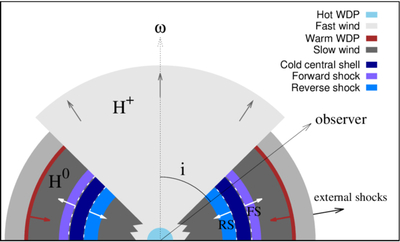
Caption: Figure 3.
Sketch for the RS Oph ejecta inferred from SED models (side view, Section 4.1). Due to the WD rotation, the wind is compressed and slowed down toward the equator at the expense of the polar directions, where we indicate a fast ionized wind (Section 4.2). The radius of the optically thick/thin compressed wind interface (i.e., the warm WDP, brown line) starts to shrink after the maximum due to its expansion and the lowering of ﹩{\dot{M}}_{{\rm{WD}}}﹩ (brown arrow; see Table 3). The earliest optically thin wind above the warm WDP (medium-gray band) shocks the surrounding much-less-dense and relatively stable giant wind. Structure of the internal shocks in the slow dense outflow was adapted according to Figure 1 of B. D. Metzger et al. (2015). White arrows indicate the propagation of forward (FS) and reverse (RS) shocks. H0 and H+ denote the neutral and ionized parts of the ejecta, and i is the orbital inclination. The axis of rotation (ω) is shown by the dotted arrow.
Other Images in This Article
Show More
Copyright and Terms & Conditions
© 2026. The Author(s). Published by the American Astronomical Society.

