

Image Details
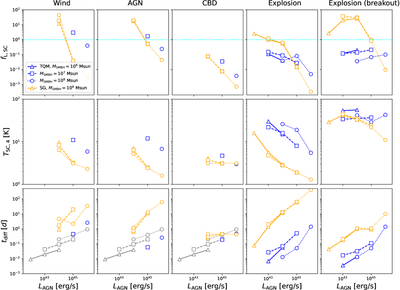
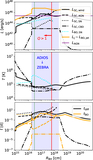
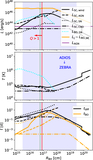
Caption: Figure 12.
Properties of flares— luminosity, temperature, and duration— as functions of AGN luminosity at locations where HAGN/RBH reaches its minimum, and mergers are more probable. The upper, middle, and lower panels show the ratio of flare luminosity to AGN luminosity (assuming a bolometric correction of 5, F. Duras et al. 2020), the radiation temperature in units of 104 K, and the diffusion timescale in days, respectively. The columns from left to right show results for cooling flares from winds, AGN-disk gas, and CBDs shocked by jets, as well as for cooling and breakout emission from AGN-disk gas shocked by SN explosions. The lines’ styles correspond to different SMBH masses: solid for 106 M⊙, dashed for 107 M⊙, and dotted for 108 M⊙. Blue and orange lines indicate the TQM and SG models, respectively. In the lower panels, the delay time between X-ray and optical emission in AGN variability (Equation (20)) is shown with gray lines. The dashed cyan line indicates fL,SC = 1, below which flares are too dim to detect. Cooling emission associated with jets from shocked winds and AGN-disk gas can be as bright as host AGN emission for LAGN ∼ 1044 − 1045 erg s−1 in the optical-UV bands. Its properties can be used to distinguish different AGN-disk models.
Other Images in This Article
Show More
Copyright and Terms & Conditions
© 2026. The Author(s). Published by the American Astronomical Society.

