

Image Details
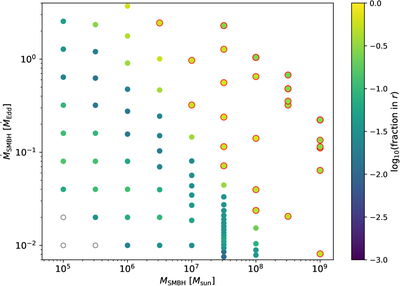
Caption: Figure 6.
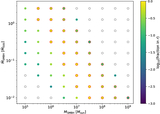
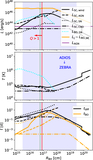
The fraction of the radial distance from the SMBH (logarithmic scale) for cases transitioning from the ADIOS to the ZEBRA state due to kicks, as a function of the SMBH accretion rate (in units of Eddington rate) and SMBH mass in the TQM model. The radial distance ranges from 6 × GMSMBH/c2 to 6 × 10⁷ × GMSMBH/c2, with an assumed BH mass mBH = 50 M⊙. Red circles highlight cases where the transition from the ADIOS to the ZEBRA state occurs at the minimum HAGN/RBH location, where mergers are more probable. Gray empty circles represent cases where no transition regions appear. We evaluate ﹩{\dot{M}}_{{\rm{out}}}﹩ at uniform logarithmic intervals separated by a factor of 2 for MSMBH≤107 M⊙ and ﹩\sqrt{2}﹩ for MSMBH > 107 M⊙, where ﹩{\dot{M}}_{{\rm{out}}}﹩ is the inflow rate at the outer boundary (6 × 10⁷ × GMSMBH/c2). This results in uneven coverage in ﹩{\dot{M}}_{{\rm{SMBH}}}﹩, reflecting its nonlinear dependence on ﹩{\dot{M}}_{{\rm{out}}}﹩. In the TQM model, when the AGN luminosity exceeds ≳1044 erg s−1, the transition from the ADIOS to the ZEBRA state is associated with kicks at the minimum HAGN/RBH region. We conclude that high-accretion rate, massive SMBHs are the most promising to produce the EM counterparts as discussed here.
Other Images in This Article
Show More
Copyright and Terms & Conditions
© 2026. The Author(s). Published by the American Astronomical Society.

