

Image Details
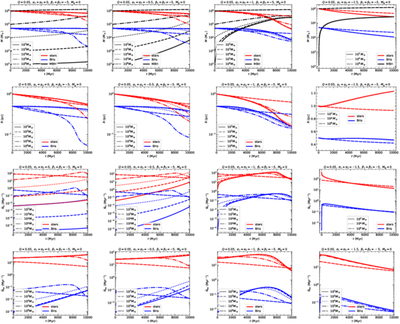
Caption: Figure 7.
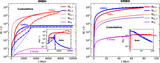
Temporal evolution of the masses (M, top row), radii (R, second row), loss-cone (﹩{\dot{N}}_{{\rm{lc}}}﹩, third row), and evaporation rates (﹩{\dot{N}}_{{\rm{ev}}}﹩, bottom row) while varying the seed mass of the central growing BH (black lines, top row). We assume stars and stellar-mass BHs have the same inner cusp slopes α1 = α2, and different columns consider different index values: α1 = 0 (left column), α1 = −0.5 (second column), α1 = −1.0 (third column), and α1 = −1.5 (right column). All other parameters of the model have been fixed. Here Q is the ratio of total mass in stellar-mass BHs (m2 = 10 M⊙) to the total mass in low-mass stars (m1 = 1 M⊙).
Other Images in This Article
Copyright and Terms & Conditions
© 2026. The Author(s). Published by the American Astronomical Society.

