

Image Details
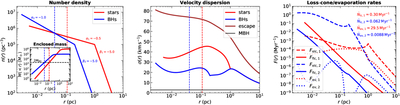
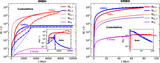
Caption: Figure 1.
Radial profiles of number densities, total enclosed masses, velocity dispersions, and loss-cone and evaporation fluxes. Left: number density of stellar-mass BHs (blue) and stars (red). A massive BH with mass MBH = 103 M⊙ is placed in the center of the system. The blue and red vertical dashed lines correspond to the influence radii of BHs and stars, respectively. The inset shows the total mass of BHs (blue) and stars (red) enclosed within radius r. The horizontal black dashed line at M(r) = 2MBH defines the influence radius. Middle: one-dimensional velocity dispersion for BHs (blue) and stars (red), as well as the escape velocity at radius r (brown curve). The horizontal black line represents the rms wandering velocity of the central massive BH. Right: full- and empty-loss-cone fluxes of BHs (blue solid and blue dashed curves) and stars (red solid and red dashed), as well as the evaporation fluxes of BHs (blue dotted) and stars (red dotted). Also shown in the upper right corner are the volume-integrated loss-cone and evaporation fluxes.
Other Images in This Article
Copyright and Terms & Conditions
© 2026. The Author(s). Published by the American Astronomical Society.

