

Image Details
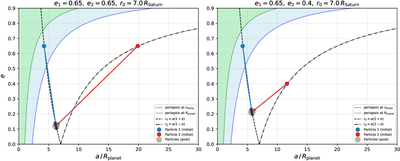
Caption: Figure A1.
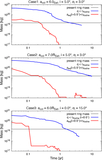
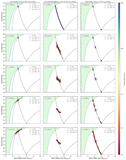
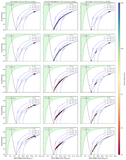
Results of direct N-body simulations including fragmentation. Only two initial particles are considered, placed on the two arms of the V-shaped distribution so that their apoapsis and periapsis coincide at acol. The simulations are stopped slightly after the first catastrophic impact between particles initially located on different arms (i.e., blue and red particles). Following the catastrophic collision, the post-impact orbital elements of fragments (a, e) shift to new positions that remain confined to the original constraint curves defined by acol = a(1 ± e). This behavior is fully consistent with the analytical framework (Section 2; Figure 2). Although secondary collisions among fragments sometimes occur before the simulation is stopped, these fragment–fragment interactions involve significantly smaller relative velocities compared to the initial inter-arm catastrophic collision, and therefore do not substantially modify the a–e evolution. The numerical results demonstrate that, even when fragmentation and secondary impacts are included, the debris evolution remains governed by the same V-shaped dynamical constraint predicted analytically.
Other Images in This Article
Copyright and Terms & Conditions
© 2026. The Author(s). Published by the American Astronomical Society.

