

Image Details
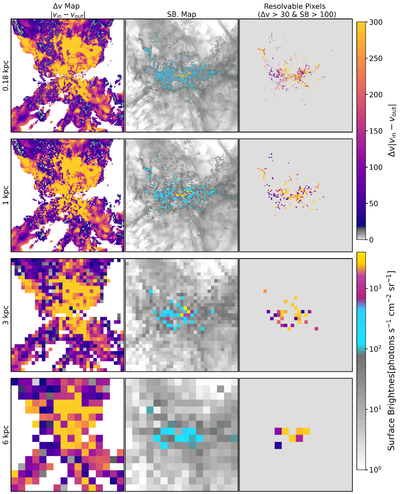
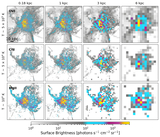
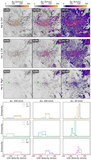
Caption: Figure 13.
Combined effects of spectral and spatial resolution on CGM kinematic observability for the Maelstrom halo using O VI emission. Each row corresponds to a different spatial resolution (0.18, 1, 3, and 6 kpc, which correspond at z = 0.5 (z = 0) to ∼ 0.04 (5.6), 0.16 (20), 0.5 (61), and 1 (120) arcsec, respectively). Left column: maps of absolute projected velocity differences (Δv) between inflowing and outflowing gas (defined as vrad < − 100 km s−1 and vrad > 200 km s−1, respectively). Gray pixels are unresolved (Δv < 30 km s−1); colored pixels indicate increasing Δv detectable at different kinematic resolutions: blue-purple (30–100 km s−1), purple-orange (100–200 km s−1), and orange-yellow (>200 km s−1). Middle column: surface brightness maps showing detectable regions above a sensitivity threshold of 100 photons s−1 cm−2 sr−1 (cyan, purple, and yellow). Right column: pixels that are resolved in both surface brightness and velocity (using Δv = 30 km s−1 and SB=100 photons s−1 cm−2 sr−1 thresholds), color coded by velocity difference. This panel shows how improved kinematic resolution enables separation of inflows and outflows in regions already observable in emission. At 30 km s−1 resolution, over 90% of the emission-resolved gas can be kinematically distinguished; at 200 km s−1, this fraction drops to ∼40%–50%.
Other Images in This Article
Show More
Copyright and Terms & Conditions
© 2026. The Author(s). Published by the American Astronomical Society.

