

Image Details
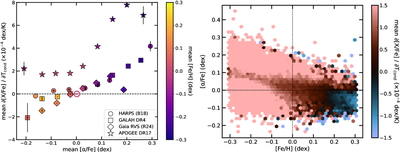
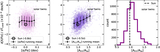
Caption: Figure 4.
Left: mean Tcond slope (﹩\frac{\partial [{\rm{X}}/{\rm{Fe}}]}{\partial {T}_{{\rm{cond}}}}﹩) as a function of mean [α/Fe] and colored by mean [Fe/H] with uncertainties on the mean for solar analogs with B18 as circles, GALAH as squares, R24 as diamonds, and APOGEE as stars. There is a positive gradient in Tcond slope with [α/Fe] (10 ± 4E-4 K−1) and a similarly strong negative gradient with [Fe/H] as well (-4 ± 1E-4 K−1). Metal-rich, α-enriched stars tend to have ﹩\frac{\partial [{\rm{X}}/{\rm{Fe}}]}{\partial {T}_{{\rm{cond}}}}﹩ = 0, consistent with the Sun. The APOGEE stars are systematically offset from the rest of the surveys, given their difference in kinematic selection. Right: [Fe/H]–[α/Fe] distribution of stars colored by their Tcond slope. We confirm what was seen on the left panel: the majority of stars with a Tcond slope consistent with zero are metal-rich and depleted in [α/Fe] compared to the Sun. Hexbin cells with mean Tcond slopes consistent with zero are centered at [Fe/H] = 0.1 dex and [α/Fe] = −0.02 dex.
Other Images in This Article
Show More
Copyright and Terms & Conditions
© 2026. The Author(s). Published by the American Astronomical Society.

