

Image Details
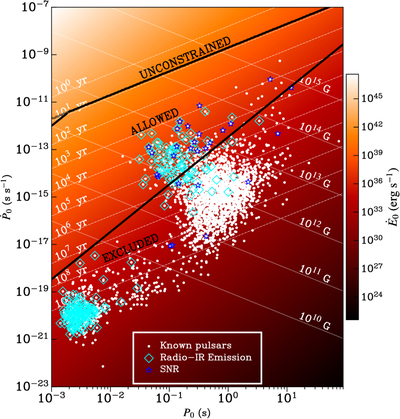
Caption: Figure 4.
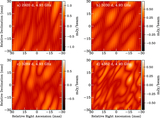
Constraints on the formation properties of the candidate NS at the center of SN 2012au, assuming the late-time radio emission is a PWN powered by spindown via magnetic dipole radiation. The initial period (horizontal axis) and period derivative (vertical axis) are used to construct the initial spindown luminosity scales (heatmap). We overplot lines of constant dipole magnetic field strength and initial spindown timescale as dotted and dashed–dotted white lines, respectively. Allowable combinations of ﹩{P}_{0},{\dot{P}}_{0}﹩, and B for SN 2012au are bounded by the central polygon. The region is bounded above by the requirement that the nebula must be contained to RPWN ≤ 1.4 × 1017 cm at t = 2925 days post-collapse (as constrained by our VLBI images). The region is bounded below by the requirement that the radio luminosity cannot be higher than the pulsar spindown luminosity. The region where no analytic constraint on the NS’s formation properties can be established (e.g., where τ0 ≲ 8 yr, where τ0 is the typical spindown timescale) is indicated by the “unconstrained” region. We overplot present-day combinations of a large sample of known pulsars, including magnetars and recycled millisecond pulsars, for comparison (R. N. Manchester et al. 2005; M. Pitkin 2018). The allowable parameter space includes a number of present-day systems associated with an SNR or radio-IR continuum emission, indicated by blue stars/cyan diamonds, respectively.
Other Images in This Article
Copyright and Terms & Conditions
© 2026. The Author(s). Published by the American Astronomical Society.

