Image Details

Choose export citation format:

The Milky Way Stellar Halo Is Twisted and Doubly Broken: Insights from DESI DR2 Milky Way Survey Observation

  • Authors: Songting Li, Wenting Wang, Sergey E. Koposov, João A. S. Amarante, Alis J. Deason, Nathan R. Sandford, Ting S. Li, Gustavo E. Medina, Jiaxin Han, Monica Valluri, Oleg Y. Gnedin, Namitha Kizhuprakkat, Andrew P. Cooper, Leandro Beraldo e Silva, Carlos Frenk, Raymond G. Carlberg, Mika Lambert, Tian Qiu, Jessica Nicole Aguilar, Steven Ahlen, Davide Bianchi, David Brooks, Todd Claybaugh, Axel de la Macorra, Peter Doel, Jaime E. Forero-Romero, Enrique Gaztañaga, Satya Gontcho A Gontcho, Gaston Gutierrez, Dick Joyce, Robert Kehoe, Anthony Kremin, Claire Lamman, Martin Landriau, Laurent Le Guillou, Ramon Miquel, Will Percival, Francisco Prada, Ignasi Pérez-Ràfols, Graziano Rossi, Eusebio Sanchez, David Schlegel, Ray Sharples, Joseph Harry Silber, David Sprayberry, Gregory Tarlé, Benjamin Alan Weaver, Hu Zou

Songting Li et al 2026 The Astrophysical Journal 999 .

  • Provider: AAS Journals

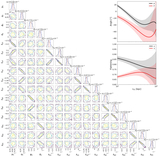
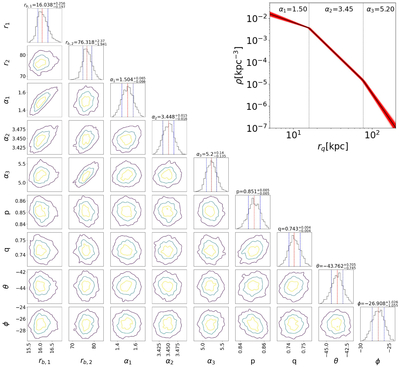
Caption: Figure 3.

Posterior contours for different combinations of nine parameters of the triple power-law model. Red and blue dashed lines indicate 50th, 16th, and 84th percentiles. The meanings of different model parameters can be found in Section 3.2. The yellow, light-blue, and dark-blue contours represent the 30%, 1σ, and 2σ regions of the MCMC post-burn distributions, respectively. The black line in the inset panel shows the selection-effect-free best-fit model radial density profile (renormalized to unity), with the red shaded region representing the 1σ model uncertainty, and two vertical black dashed lines mark two break radii.

Other Images in This Article
Show More

Copyright and Terms & Conditions

Additional terms of reuse