

Image Details
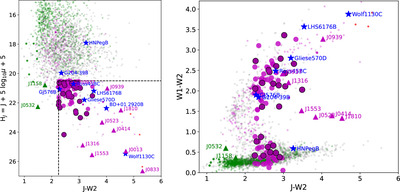
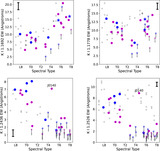
Caption: Figure 1.
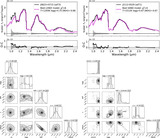
Left panel: selection of candidate T subdwarfs from BYW targets (small gray dots). Semitransparent circles indicate disk late-M and -L dwarfs (green), T dwarfs (magenta), and Y dwarfs (red) from the compilation of W. M. J. Best et al. (2018), while opaque circles indicate metal-poor objects from that compilation and from Z. H. Zhang et al. (2018a). We label previously identified late-L (green triangles) and -T (magenta triangles) subdwarf comparison sources and some of the benchmark companions (blue stars) from our spectroscopic sample (Tables 2 and 3). We delineate our selection criteria of J − W2≥ 2.25 mag and HJ ≥ 20.5 mag with dashed lines. All candidates are indicated by large magenta circles, while those with spectroscopic observations reported in this study are further highlighted by black outlines. Right panel: W1 − W2 vs. J − W2 color–color diagram of the same sample. Note that sources without W1 detections are not shown in this plot.
Other Images in This Article
Show More
Copyright and Terms & Conditions
© 2025. The Author(s). Published by the American Astronomical Society.

