

Image Details
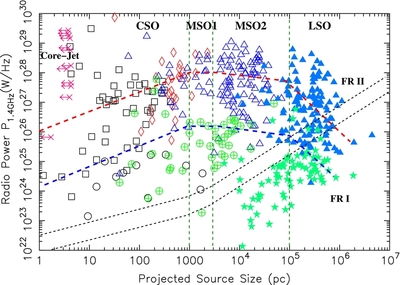
Caption: Figure 1.
Radio power vs. the linear extent of large-scale radio sources: compact, medium-sized, and large symmetric objects. Exemplary evolutionary tracks based on parametric modeling are depicted for the high-radio-power and low-radio-power sources using red and blue dashed lines. The black dashed lines mark the (approximate) boundary between stable laminar jet flows (above the lines) and unstable turbulent flows (below the lines). Symbols represent different morphological and spectral classes of radio sources (number of data points in bracket): black square: CSO (46), black circle: low-power GPS (12), red diamond: high-power GPS (27), purple cross: HFP (12), green circle: low-power CSS (114), blue open triangle: high-power CSS (44), blue filled triangle: FR II (140), and green filled star: FR I (79). Catalog references for Figure 1: Akujor & Garrington 1995 (High-Power CSS); Black et al. 1992 (FR II); Bogers et al. 1994 (FR II); Bridle et al. 1994 (FR II); Dallacasa et al. 2002a (High-Power CSS); Dallacasa et al. 2002b (High-Power CSS); de Vries et al. 2009 (Low-Power GPS); Fanti et al. 1987 (FR I and FR II); Fanti et al. 2001 (High-Power CSS); Kunert-Bajraszewska et al. 2010 (Low-Power CSS; K10); Kunert-Bajraszewska et al. 2006 (Low-Power CSS; K06); Laing et al. 1983 (FR I and FR II); Leahy et al. 1989 (FR II); Leahy & Perley 1991 (FR I and FR II); Liu et al. 2007 (High-Power GPS; L07); Orienti & Dallacasa 2012 (HFP; OD12); Orienti et al. 2007 (HFP; O07); Orienti et al. 2010 (HFP; OD10); Orienti et al. 2006 (HFP; O06); Stanghellini et al. 1998 (High-Power GPS; S98) and Xiang et al. 2006 (High-Power GPS; L06).
Other Images in This Article
Copyright and Terms & Conditions
© 2012. The American Astronomical Society. All rights reserved.

