

Image Details
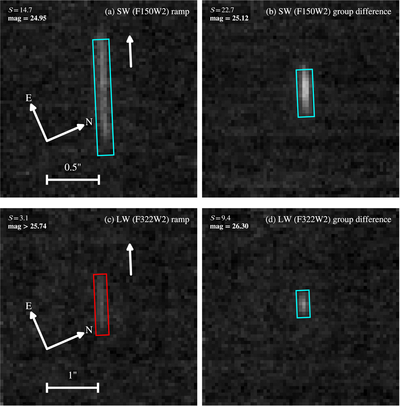
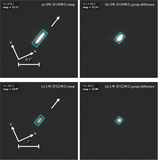
Caption: Figure 5.
Faint-limit recovery of candidate moving object Tracklet 1. (a) A stack of nine short-wavelength ramp-fit exposures. The individual exposures making up the stack of images have effective integration times of Tint = 204 s. The asteroid appears as an elongated trail. (b) 27 shift-and-stacked group differences, with the same total exposure time but with the individual images comprising the stack having an effective exposure of 51 s. The asteroid’s trail is shortened by a factor of ∼2. (c), (d) The same as (a) and (b), but in the long-wavelength detector, which has a 2× coarser pixel scale. ﹩{\boldsymbol{ \mathcal S }}﹩ is calculated using Equation (7). The object falls below our detection threshold of ﹩{\boldsymbol{ \mathcal S }}=5﹩ in the ramp-fit image in F322W2. It is recovered in the corresponding group difference image. We define a channel with ﹩{\boldsymbol{ \mathcal S }}\lt 5.0﹩ (Equation (7)) as a nondetection, and for nondetected channels we report a 5σ upper limit on the source flux.
Other Images in This Article
Show More
Copyright and Terms & Conditions
© 2026. The Author(s). Published by the American Astronomical Society.

