

Image Details
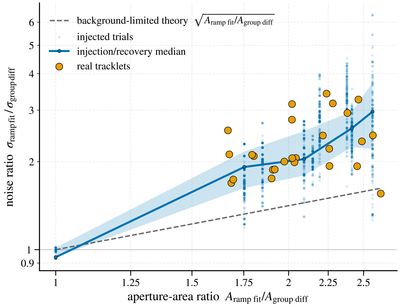
Caption: Figure 10.
Detection-noise ratio σramp fit/σgroup diff versus aperture-area ratio Aramp fit/Agroup diff. Both F150W2 and F322W2 measurements have been aggregated together. Small points are individual injected trials. The solid line and shaded band give the per-speed median and 1σ. As the chosen apertures in ramp-fit and group difference images nominally measure the same source flux, the SNR boost is driven by the reduction in the noise in the group-difference aperture resulting from its smaller size. The filled orange circles are the measurements for real candidate movers. At v = 0 (aperture-area ratio of 1), the noise ratio is close to unity, with a median value of 0.94 ± 0.01. At nonzero speeds, the noise in each aperture grows beyond that expected from a uniform white background (i.e., ﹩\sigma \propto \sqrt{A}\propto \sqrt{{n}_{\,{\rm{pix}}\,}}﹩, Equation (2)). This is likely caused by additional sources of systematic noise in each moving aperture, such as PSF wing contamination, a spatially varying background, detector systematics, etc. We do not attempt to model systematic noise explicitly, and instead characterize it empirically within our simulation. The noise ratio for our real candidate movers is consistent with our injected sources in our simulation.
Other Images in This Article
Show More
Copyright and Terms & Conditions
© 2026. The Author(s). Published by the American Astronomical Society.

