

Image Details
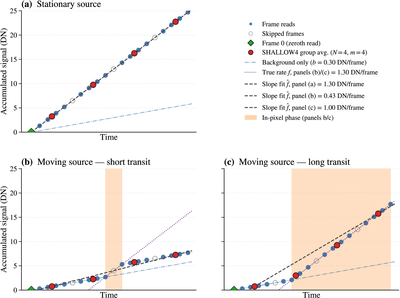
Caption: Figure 1.
Up-the-ramp slope fitting applied to a stationary versus a moving source, illustrated for the NIRCam SHALLOW4 readout pattern (N = 4 groups, each averaging m = 4 frames with one frame skipped). Read noise is neglected in this example. (a) For a stationary source, the accumulated charge rises linearly with time, and the slope fit through the group averages (red points) recovers the true count rate exactly. (b) The same fit applied to an asteroid that transits the pixel within a single intergroup interval (orange band). (c) A more general case in which the source transit overlaps multiple groups (in this case three) and their frame-averaging windows, distributing the source signal across multiple adjacent group differences. f is the true count rate of the asteroid, while the estimator ﹩\hat{f}﹩ underpredicts the true rate due to the source only being present in the pixel for a limited time. The additional noise contribution by the background from epochs where the source was not present in the pixel degrades the SNR of moving objects in standard full-ramp calibrated products. In the background-noise regime, the slope-fit weights collapse to the difference between the last and first groups in the ramp, photometrically equivalent to a destructive CCD read of the same length.
Other Images in This Article
Show More
Copyright and Terms & Conditions
© 2026. The Author(s). Published by the American Astronomical Society.

