

Image Details
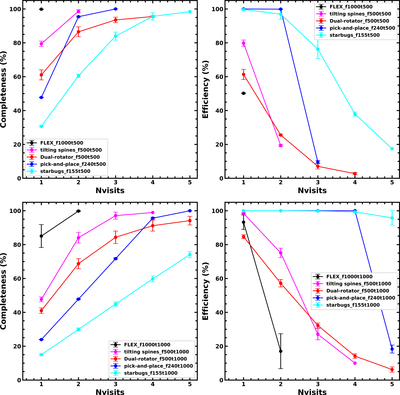
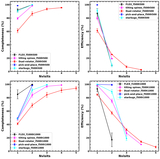
Caption: Figure 5.
Completeness and efficiency as a function of the number of visits (Nvisits) for different fiber-positioning systems (tilting spines, dual rotator, pick-and-place, and starbugs) within a 1﹩\mathop{.}\limits^{{\unicode{x000b0}}}﹩0 diameter (0.785 deg2) FoV, except for the FLEX system. For FLEX, a 0﹩\mathop{.}\limits^{{\unicode{x000b0}}}﹩5 diameter (0.196 deg2) FoV is adopted. The left panel in each row shows completeness (%), while the right panel shows efficiency (%). The top panel corresponds to 500 targets and the bottom panel corresponds to 1000 targets, respectively, for different fiber densities. As Nvisits increases, completeness improves, approaching 100%, while efficiency decreases due to fiber reallocation constraints. The trends vary across different positioning systems, reflecting their relative performance in fiber assignment for different target densities.
Other Images in This Article
Copyright and Terms & Conditions
© 2026. The Author(s). Published by the American Astronomical Society.

