

Image Details
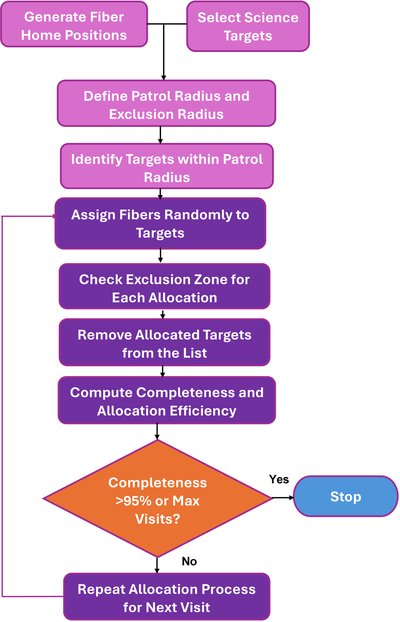
Caption: Figure 1.
The flow chart of the proof-of-concept code illustrates the step-by-step process involved in the fiber-allocation procedure. The process begins with target selection, where the input catalog of astronomical objects is filtered based on observational priorities and constraints. At the same time the fiber home positions are generated to uniformly distribute the fibers over a chosen FoV. The algorithm then identifies targets within each patrol radius (PR) (for parallel-positioner systems), ensuring that each fiber can only access a defined region to prevent overlaps. Fiber assignment is performed through a random allocation process, where available fibers are assigned to targets while strictly enforcing PR and exclusion constraints (e.g., preventing multiple fibers from selecting the same target or overlapping patrol zones). Once an initial allocation is made, assigned targets are removed from the available pool to mimic the observation process and these stages are iterated across multiple subsequent visits until the nominated completeness requirement is achieved. The final output consists of a set of completeness and efficiency metrics as a function of each visit, to establish the performance of any given system that can then be compared against others.
Other Images in This Article
Copyright and Terms & Conditions
© 2026. The Author(s). Published by the American Astronomical Society.

