

Image Details
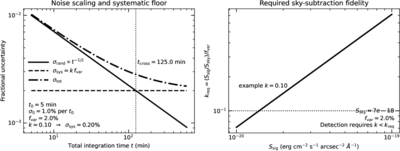
Caption: Figure 3.
Noise scaling and sky-subtraction requirements for ULSB detection. Left: fractional uncertainty as a function of total integration time. Random noise decreases as σrand ∝ t−1/2, while intrinsic sky variability imposes a systematic floor σsys = kfvar. For a representative per-exposure uncertainty σ0 = 1% at t0 = 5 min and intrinsic sky variability fvar = 2% (Figure 2), an illustrative leakage factor k = 0.1 produces a systematic floor σsys = 0.2%. The crossover time tcross = 125 min marks the transition to a systematics-limited regime, beyond which additional integration yields diminishing returns unless sky subtraction is improved. Right: required sky-subtraction fidelity to detect a target signal Ssig against a sky background Ssky. The required leakage factor is kreq = (Ssig/Ssky)/fvar, and detection requires k < kreq. For typical dark-sky continuum levels (Ssky ∼ 7 × 10⁻¹⁸ erg cm−2 s−1 arcsec−2 Å−1), detecting 10−19 requires k ≲ 0.7, whereas detecting 10−20 requires k ≲ 0.07, corresponding to suppression of more than 90% of the intrinsic sky variability.
Other Images in This Article
Copyright and Terms & Conditions
© 2026. The Author(s). Published by the American Astronomical Society.

