

Image Details
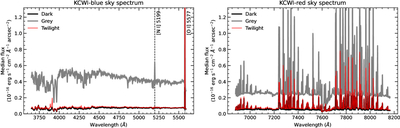
Caption: Figure 1.
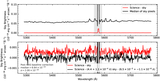
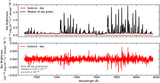
Representative KCWI-blue (left) and KCWI-red (right) sky spectra under dark, gray (moonlit), and early twilight conditions. The dark and twilight spectra are derived from a continuous observing sequence obtained on 2024 February 8 consisting of 13 consecutive 5 minute exposures. The dark-sky spectrum is constructed from the first twelve exposures, while the twilight spectrum corresponds to the final exposure acquired near the start of astronomical twilight. The gray-sky spectra are derived from a separate moonlit observing sequence obtained on 2023 October 22 consisting of fourteen consecutive 5 minute exposures. Under dark conditions, the sky continuum is ﹩\sim 7\times 1{0}^{-18}\,{\rm{erg}}\,{{\rm{cm}}}^{-2}\,{{\rm{s}}}^{-1}\,{{\rm{arcsec}}{}^{-2}\,\mathring{\rm A} }^{-1}﹩ in both channels. The blue channel is characterized by narrow atomic airglow lines, including [N I] λ5199 and [O I] λ5577, while the red channel is dominated by strong OH Meinel bands and telluric O2 absorption near ∼7600 Å. Gray conditions increase the sky continuum through scattered moonlight, raising the background level by factors of ∼6 in the blue and ∼4 in the red. Later in twilight, the continuum increases and modifies the relative prominence of atmospheric emission features.
Other Images in This Article
Copyright and Terms & Conditions
© 2026. The Author(s). Published by the American Astronomical Society.

